
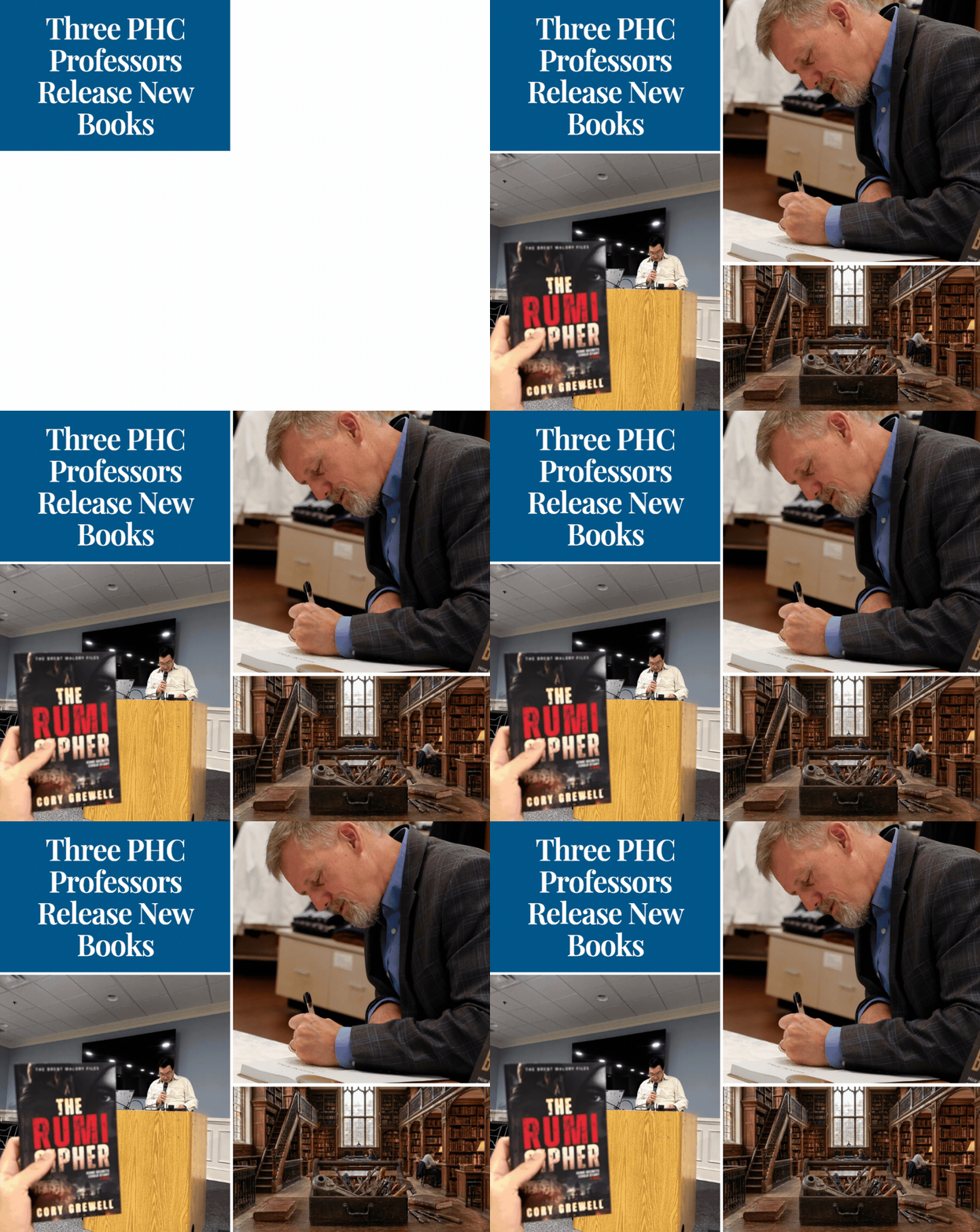
Dr. Mark Mitchell, Dr. Cory Grewell, and Dr. Gregory Moore have turned their interests and expertise into published work, exploring subjects from detective fiction and artificial intelligence to understanding international affairs. Their books offer readers opportunities to engage with the questions, ideas, and disciplines that shape their work both inside and beyond the classroom.
Three recent books by these PHC faculty members reflect that breadth of interest: Grewell’s The Rumi Cipher, Mitchell’s Breaking Babel: How a Mysterious Biblical Story Can Help Christians Survive the AI Revolution, and Moore’s An International Relations Research Methods Toolkit.
Examining the Digital Power of Babel
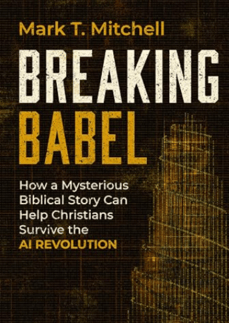 Dr. Mark T. Mitchell uses his book Breaking Babel to look at the cultural and spiritual consequences of modern technology through the biblical account of the Tower of Babel. The book considers how digital technology shapes human attention, consciousness, and relationships, while questioning the ambitions behind an increasingly interconnected technological world.
“Framing this topic in terms of the Tower of Babel helped the pieces fall into place and provided a narrative structure to the project,” Mitchell said. “The Babel story is rich and merits serious attention.”
The book draws a connection between the biblical attempt to overcome human limitations and contemporary technological ambitions. Mitchell argues that the pursuit of unlimited power and even immortality through technology cannot ultimately escape the realities of human nature and human limitation.
 His goal is not simply to encourage readers to consider the latest technological developments, but to examine the assumptions and consequences that often go unnoticed as technology becomes part of everyday life.
“I want people to think seriously about the world we are building and the technologies that are, because of their ubiquity, becoming invisible,” Mitchell said. “We must think hard and clearly about what we are doing. Clear thinking is the necessary first step to wise action.”
A Private Investigator's Search for Redemption
 In The Rumi Cipher, Dr. Cory Grewell takes readers into the world of private investigation. The novel follows Brent, a Boston private investigator (P.I.) hired to protect a Palestinian poet who has become the target of an assassination plot. As he investigates the growing threat, Brent encounters political complications and a woman whose knowledge of the danger raises more questions than it answers.
The private investigator genre naturally fits Grewell’s interests as a writer. He traces his appreciation for the genre to the novels of Robert B. Parker, Raymond Chandler, and Ross Macdonald. “The P.I. novel is a story of redemption, but it’s also gritty and tragic and tough,” Grewell said. “Every time I read a good one, I get inspired about life, about the adventure of finding and doing the right thing in a fallen world.”
That search for truth also shapes what Grewell hopes readers take from the novel. He wants them to look beyond surface appearances and consider people more deeply, particularly those whom others might dismiss.
“The P.I., again, as Chandler says, goes down the mean streets of life to redeem those who others often just write off,” Grewell said. “Jesus did that too. I hope this novel makes my readers look deeper at people, hopefully the way Jesus did.”
Dr. Grewell has already drafted a second novel, The Thorndike Confession, which is awaiting final edits. He hopes to publish it in the first half of next year, with additional books to follow.
“Writing this sort of thing is my passion, and I think, my vocation,” he said.
Giving Researchers the Right Tools
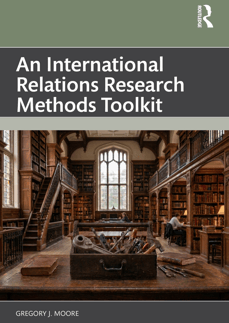 Dr. Gregory Moore’s An International Relations Research Methods Toolkit addresses a different kind of challenge: How to help students and scholars approach research questions effectively.
The book introduces readers to the foundations of research design, including ontology, epistemology, and methodology. It guides readers through the process of developing research questions and hypotheses, structuring projects, and presenting findings. It also includes an introduction to 40 commonly used research tools with suggestions for further reading.
Moore’s own experience teaching political science research methods planted the seed for the book. He first developed an article on ontology, epistemology, and research methods in 2007, gradually expanding it as he found the material useful in his classes.
“When teaching political science research methods over the years, I could not find good books that covered what I thought should be covered, so I decided to write the book that I wanted,” Moore said.
The central idea behind the book is that effective research depends on selecting the appropriate method for the question being asked. Moore uses the image of a toolkit to explain why researchers benefit from familiarity with a variety of approaches.
“Questions drive research, and the methods one uses are what allow the researcher to get at the problem being researched, and help the researcher answer the question,” Moore said.
Moore hopes the book will equip students and other researchers to conduct stronger studies and answer a wider range of questions. He is also considering writing a version directed more broadly toward political science students, extending the book’s approach beyond the field of international relations.
To conclude...
At Patrick Henry College, faculty scholarship reflects the college’s commitment to thoughtful inquiry, intellectual engagement, and the pursuit of truth. Through fiction, cultural analysis, and practical instruction, Grewell, Mitchell, and Moore invite readers to examine the world more carefully and consider questions that reach across their respective fields. Their books offer a glimpse of the scholarship and expertise PHC faculty bring to their teaching and contribute to their academic disciplines.
Patrick Henry College exists to glorify God by challenging the status quo in higher education, lifting high both faith and reason within a rigorous academic environment; thereby preserving for posterity the ideals behind the "noble experiment in ordered liberty" that is the foundation of America.