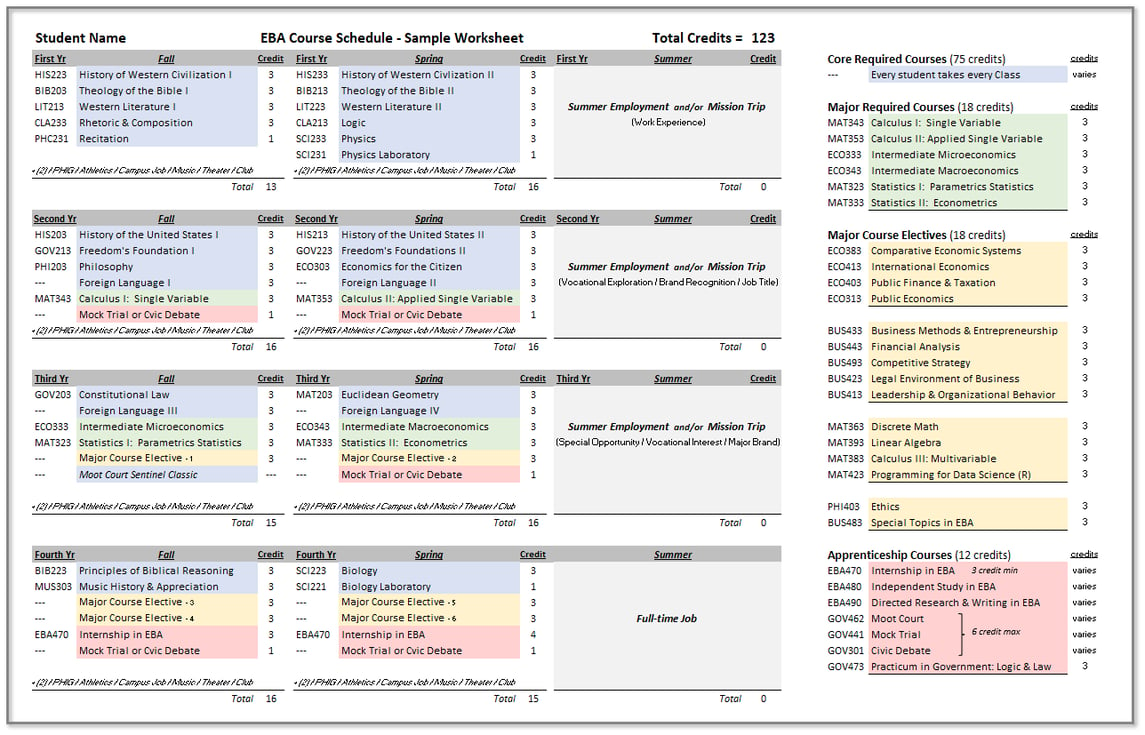
Below is an example of a four-year course schedule for the EBA Major. Every student will have a unique path. Full course descriptions of the major required and major elective courses available in the EBA major are listed below the sample course schedule.
ECO303 • Economics for the Citizen (required)
This course develops an understanding of how markets work and builds to a survey of political economy. A key element is the presentation of the "economic way of thinking," and its goal is to help make better sense of the world in which we live.
ECO313 • Public Economics (elective)
This course builds on the analysis of markets to develop an institutional framework for the role of government in the economy. Topics will include the nature and limits of government actions, and its effect on market activity. The goal is to develop a comprehensive understanding of the processes by which resources are acquired and employed by the public sector and a greater insight as to the ultimate impact of these decisions.
ECO333 • Intermediate Microeconomics (required)
This course builds on many of the concepts and theories learned in ECO303, introducing formal analytical tools such as linear algebra and differential calculus to provide an advanced understanding of microeconomic theory. Following this class, students will be prepared to model and understand the economic decisions faced by individuals, firms, and government, and to analyze how changes in the economic environment impact these choices. Topics covered include consumer and producer theory, general equilibrium, industrial organization, and game theory.
ECO343 • Intermediate Macroeconomics (required)
This course builds on many of the concepts and theories learned in ECO303, introducing formal analytical tools such as linear algebra and differential calculus to provide an advanced understanding of macroeconomic theory. Following this class, students will be prepared to model and analyze how changes in the macroeconomic environment influence the functioning of an economy. Students will also be exposed to a number of alternative theories of macroeconomics, including the Austrian, Keynesian, Public Choice and New Institutional schools of thought. Topics covered include economic growth, inflation, unemployment, and fiscal and monetary policy.
ECO383 • Comparative Economic Systems (elective)
Understanding the implications of various economic systems and policies for the well-being of a nation’s citizens is vitally important for anyone who hopes to participate in the formation of such policies. Comparative Economic Systems builds from a foundational knowledge of markets and market processes with an exploration of international and domestic economic systems, historical and current, to understand their implications. Areas of study include mercantilism, capitalism, statism, “hard” and “soft” socialism, closed and open trade, and protectionism.
ECO403 • Public Finance & Taxation (elective)
This class builds on a basic knowledge of economics and explores both the concepts and applications of taxation and public spending. General topics covered include government revenues and expenditures. Of particular interest are items such as taxations, subsidies, social security, health care, low-income assistance, income distribution, and the budgetary process for government programs and bureaus. The goal is to develop applicable understanding and knowledge of the short and long-term productive, moral, incentive, and efficiency effects of government spending.
ECO413 • International Economics (elective)
International trade and monetary theory. International trade topics focus on the effects of international trade and protection on various sectors of the economy and on a country’s overall welfare. International monetary topics include balance of payments, exchange rates, capital movements, and international monetary organizations.
BUS413 • Leadership & Organizational Behavior (elective)
This course is designed to help students both discover and develop their own leadership capability in a Christ-centered paradigm. Biblical, historical and contemporary models of leadership will be studied along with practical tools and approaches to encouraging others and being a leader other are excited to rally around. These lessons will be made practical by placing them in a business context so students will simulate how they might respond to common situations.
BUS433 • Business Methods & Entrepreneurship (elective)
This course exposes students to a broad range of vernacular, concepts and roles essential to the efficient functioning of a business entity. In addition to understanding these individually, the integration of concepts of roles is developed to understand the overall functioning of a business entity.
BUS443 • Financial Analysis: Case Study Methodology (elective)
This course introduces corporate financial analysis with an emphasis on company valuations and financial statements such as Cash Flow, Balance Sheet and Income Statements. Key ideas, concepts and tools will be introduced for proper financial analysis of a firm. Harvard Business School case studies will be used throughout the course to emphasize real-world applications to complex problems.
BUS493 • Competitive Strategy (elective)
This course is designed as an upper-level course in strategy. Students will learn the history and meaning of strategy. Topics covered will include the structural analysis of industries, early definitions of generic business unit strategies, frameworks for competitor analysis, and strategies within changing industry environments. In addition, students will discuss military strategy, analyze strategy of existing companies, and examine the different types of strategic decisions within an industry. The course will explore why some enterprises gain an economic advantage within an industry while others simply struggle to exist. A Business Case Study will be used in the course to emphasize real-world applications to complex problems.
BUS423 • Legal Environment of Business (elective)
This course covers various legal concepts and how they directly impact businesses. The course will cover topics such as: laws covering commercial disputes, property rights, contract law, intellectual property, regulatory law and international law. In addition, the course will discuss different types of business organizations, debt and equity, private equity, and capital markets. The class will focus on real-world issues and how laws affect decision making and will also provide an overview of various legal professions (litigation, corporate law, regulatory law, etc.).
MAT323 • Statistics I: Parametric Statistics (required)
This course introduces the theory and application of statistics; including probability, distributions, randomness, testing, and correlation. Preexisting familiarity with calculus is helpful but not required.
MAT333 • Statistics II: Econometrics (required)
This course develops additional instruction in the theory and, in particular, the application of statistics to business analytics, economics, and econometrics. Data analysis, regressions, variance estimation, multivariate analysis, and hypothesis testing are addressed in this course.
MAT343 • Calculus I: Single Variable Calculus Theory (required)
This course introduces calculus in one dimension. A review of functions leads to an exploration of limits and continuity. Building on these two concepts, derivatives, integrals, and the fundamental theorem of calculus are introduced. Derivates and integrals are then applied to a variety of problems.
MAT353 • Calculus II: Applied Single Variable Calculus (required)
This course builds additional proficiency in calculus in one dimension. A study of transcendental functions in calculus equips students to tackle applications. Advanced integration techniques, along with infinite sequences and series, then arm students to solve problems like first-order differential equations.
MAT383 • Calculus III: Multivariable Calculus (elective)
Calculus III focuses on the multi-dimensional derivatives and integrals, in contrast to the single-dimensional analyses of Calculus I and Calculus II. Topics covered include vectors, curves, partial derivatives, gradients, multiple and iterated integrals, and calculus of functions of three independent variables.
MAT363 • Discrete Math (elective)
An introduction to fundamental mathematical concepts used in mathematics as well as computer science. The topics covered include logic, elementary set theory, direct and indirect proofs, mathematical induction, set theory, function, relations, and graph theory. This course serves as an introduction to mathematical thought and pays particular attention to helping students learn how to write proofs.
MAT393 • Linear Algebra (elective)
An introduction to matrix algebra and abstract vector spaces with an emphasis on writing mathematical arguments. Topics include linear systems and matrices, vector spaces, linear independence, eigenvalues, and eigenvectors. The study of vector spaces over the real and complex numbers introducing the concepts of subspace, linear independence, basis, and dimensions; systems of linear equations and their solution by Gaussian elimination; matrix operations; linear transformations and their representations by matrices; eigenvalues and eigenvectors; and inner product spaces. The course will feature both proofs and applications, with special attention paid to applied topics such as least squares and singular value decomposition.
MAT423 • Programming for Data Science (R) (elective)
This course will develop proficiency in the basic operations, data structures, and code of the R programming language for Data Science. This language will be the primary focus of the course. The course will introduce students to the underlying concepts of data manipulation, data visualization, data modeling, and statistical analysis. Students will learn how to write modular, reusable code while establishing good habits around software development, documentation, and data management. Students will be assigned applied projects that integrate statistical reasoning with computational software.